Dear 3/4 Community,
Welcome to another exciting edition of our Grade 3/4 newsletter! It has been a busy and rewarding fortnight filled with rich learning experiences across all curriculum areas. As always, thank you for your continued support. We appreciate the important role you play in your child’s learning and value the strong partnership we share between home and school.
Reading
Over the past fortnight, students have been exploring the wonderful world of poetry. We have been reading a range of poems from T.S. Eliot’s Old Possum’s Book of Practical Cats, including The Naming of Cats, The Old Gumbie Cat and Mr Mistoffelees.
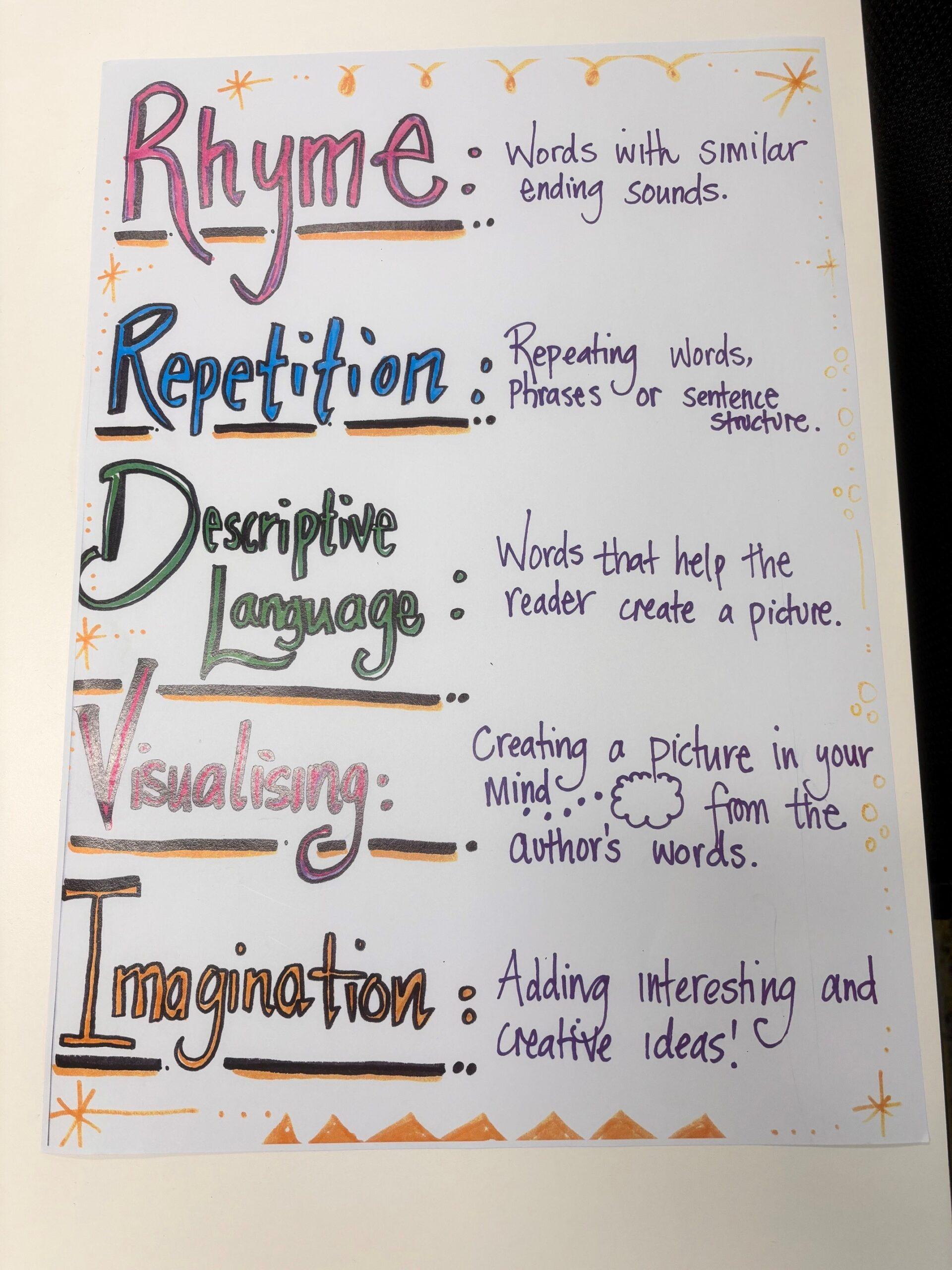
Students have been developing their reading fluency through choral and partner reading, while learning how poets use different language features to make their poems engaging and memorable. We have focused on rhyme, repetition and descriptive language, discussing how these features help create rhythm, emphasise ideas and paint vivid pictures in our minds.
Students have also been practising the reading strategy of visualising. They used descriptive language from Mr Mistoffelees to imagine what the magical cat might look like and then created their own illustrations, supporting their ideas with evidence from the poem.
To finish the sequence, students became “Poetry Detectives”, applying the skills they had developed throughout the week. They searched for rhyme, repetition and descriptive language and used evidence from the text to explain their thinking.
Students also continued to build their reading stamina and independence through Reading Eggspress and Get Epic, selecting appropriate texts and practising their fluency and comprehension skills.
At home: Encourage your child to read poetry aloud with you. Have a go at finding words that rhyme, spotting repeated phrases or discussing the pictures they create in their mind as they read.
Maths
In Maths, we have been learning all about time and how we use it in everyday life. Students were introduced to 24-hour time, exploring where they might see it in the real world, such as on bus and train timetables, digital devices and travel schedules. They practised matching 12-hour and 24-hour times and reading simple timetables.
We then focused on converting units of time, including minutes and hours, hours and days, and days and weeks. Students used strategies such as skip counting, repeated addition and multiplication to help solve time conversion problems.
Students also explored elapsed time, learning how to calculate how much time has passed between a start and finish time. They practised using number lines and counting on to solve practical problems.
To bring these skills together, students worked with real-life timetables and multi-step problems, using information about buses and travel to solve questions involving AM and PM, duration and elapsed time. Students were encouraged to show their working and explain the strategies they used to solve each problem.
We finished our time unit with a summative assessment, giving students the opportunity to demonstrate their understanding and reflect on their growth throughout the unit.
At home: Time is a great skill to practise in everyday situations. Ask your child questions such as, “If we leave at 3:20 and it takes 35 minutes, what time will we arrive?” or look at a bus, train or television timetable together and discuss the times you can see.
This week, we have begun an exciting new unit on fractions. We started by completing a pre-assessment to help identify what students already know before beginning our learning.
Students then explored fractions using hands-on materials, including apples, to understand that fractions represent equal parts of a whole. They learnt the important vocabulary of numerator and denominator and investigated common unit fractions such as halves, thirds and quarters.
As our understanding developed, students represented fractions on number lines, learning that fractions are placed between whole numbers using equal partitions. They practised locating fractions including ½, ⅓, ¼, ⅔ and ¾ and discussed how the denominator tells us how many equal parts the whole has been divided into.
We also explored equivalent fractions, discovering that different fractions can represent the same amount. Students used interactive activities, including creating fraction hopscotch games, to identify and generate equivalent fractions such as ½ and 2/4.
To finish the week, students investigated fractions of a collection, using counters and arrays to share groups of objects equally and identify fractional parts of a set.
At home: Fractions are everywhere! You might ask your child to help share food equally at dinner, cut a sandwich into halves or quarters, or ask questions such as “If we have 12 strawberries, what is one quarter of the collection?” These everyday conversations help strengthen their understanding of fractions in meaningful ways.
Writing
In Writing, students have been putting their poetry skills into practice and beginning to write like poets themselves. Building on our Reading lessons, we have explored how rhyme, repetition and descriptive language can make poetry interesting and enjoyable to read.
Students first focused on rhyme, learning that rhyming words need to sound alike while also making sense within the poem. They experimented with rhyming pairs and created short poems about cats, carefully choosing words that worked both for their rhyme and their meaning.
We then looked at The Old Gumbie Cat for inspiration. Students used repetition and descriptive language to create their own verses about animals. They thought carefully about words that would help their readers create a picture in their minds and experimented with repeated phrases to create rhythm and emphasis. Students then illustrated their verses to match their descriptions.
To finish the week, students became independent poets, creating their own animal poems using the skills they have developed throughout the week. They planned and wrote poems incorporating rhyme, repetition and descriptive language, before rereading, editing, illustrating and sharing their work with others.
It has been wonderful to see students becoming more confident in experimenting with words and discovering that poetry is a great way to play with language and use their imagination.
Next week, we will continue our poetry unit by exploring a new style of poetry called Haiku.
Students will learn about the traditional three-line structure of a haiku and investigate the 5–7–5 syllable pattern. They will practise identifying and counting syllables in words before exploring how poets carefully select descriptive language to create a strong image in the reader’s mind.
Students will then plan and write their own animal-themed haiku. They will brainstorm what their animal looks, sounds and moves like and consider the setting it lives in. Students will draft, edit and refine their poems, making thoughtful word choices to ensure their writing follows the 5–7–5 structure while still creating a clear picture for the reader.
To finish, students will illustrate their haiku and share their poems with a partner or the class. This will provide another opportunity for students to read their writing aloud and celebrate their creativity.
This will build beautifully on our learning from this week, where students experimented with rhyme, repetition and descriptive language, while introducing them to a new poetry structure and showing them that poets can use different techniques to create an effect.
Inquiry
In Inquiry, we have continued exploring forces and motion, with a particular focus on gravity and friction. Students investigated how different surfaces can affect the movement of an object and explored the idea that friction can slow down movement caused by gravity.
Students designed and built their own spinning tops before testing them across a range of different surfaces, including smooth tables, sandpaper, carpet, plastic and aluminium foil. They observed how the tops moved and compared the results from each surface.
Through this hands-on investigation, students developed their understanding of gravity, friction and air resistance and began to explain how these forces can affect the movement of objects. They also practised making observations, testing ideas and using evidence from their experiments to explain what they discovered.
At home: Encourage your child to look for examples of friction and gravity in everyday life. Ask questions such as, “Why is it easier to slide something across a smooth surface than carpet?” or “Where can you see gravity helping or slowing something down?”
Looking ahead to next week
Next week, we are very excited to be heading to Scienceworks for an exciting hands-on learning experience that will connect directly with our current Inquiry unit on forces and motion.
Students will explore how forces work in the world around us, investigating concepts such as movement, gravity, friction, energy and how forces can be used to make things work. This will build on the experiments we have been conducting in the classroom, where students have been investigating how forces such as gravity and friction affect the movement of objects.
The excursion will provide students with an opportunity to see these concepts in action, ask questions, experiment and make connections between what we have been learning at school and how forces are used in the real world.
We are looking forward to a fun and educational day of exploring, experimenting and discovering how forces make things move!